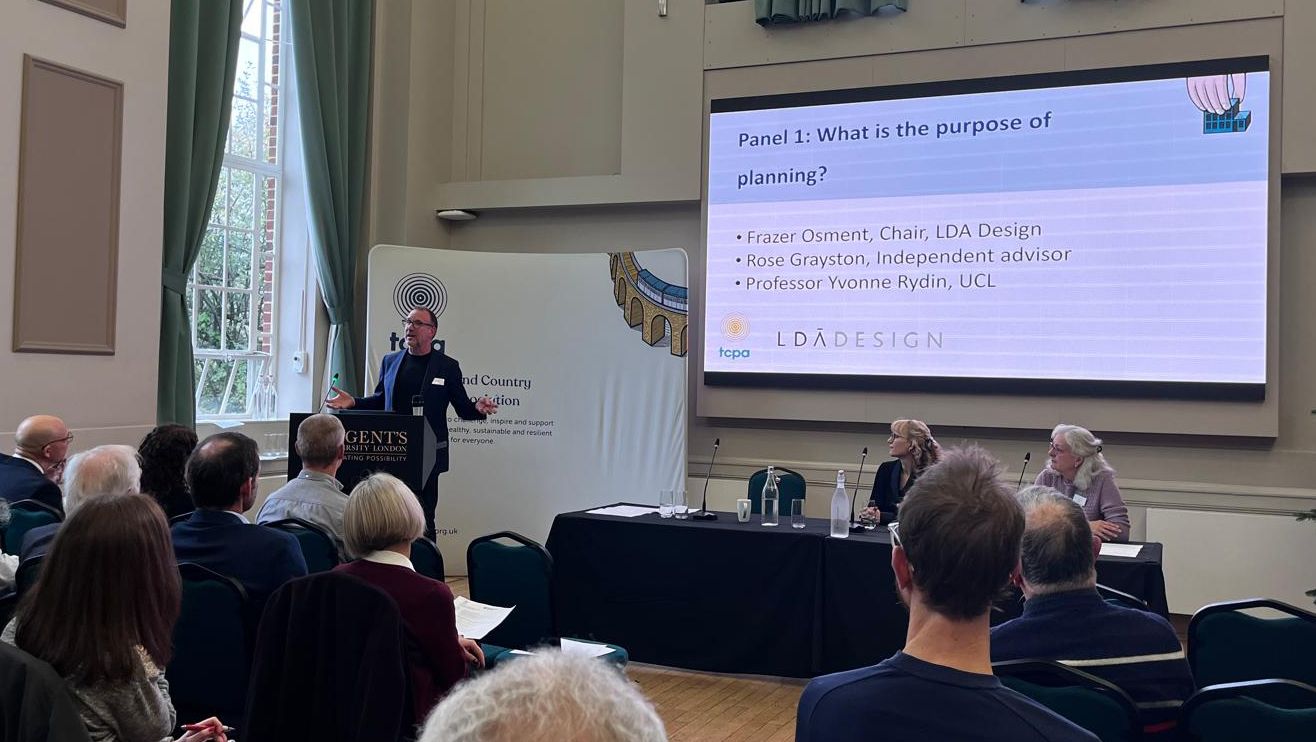
Frazer Osment, Chair of LDA Design, shares reflections from the TCPA Annual Conference 2025
What became clear as the recent TCPA annual conference got underway was that talk of changes to Planning could go on for ever, while the perfect system hovered for ever just over the horizon.
Those of us working in the built environment should engage with the system as it is now, with all its shortcomings.
So, it felt high time that those of us working in the built environment should engage with the system as it is now, with all its shortcomings. While also being highly creative and entrepreneurial about how it can be used to deliver the kinds of places we long to see.
Put simply, there is nothing stopping a collective change of mindset right now. One that challenges false binary choices, whether they are between different policy positions or between people and planet. With a new focus instead on how to work better together to meet the genuine needs that are clear to see up and down the country.
Planners can move forward with more confidence in the role they play in changing not just places, but lives.
There’s little doubt that legislation giving planning clear purpose and ambition will help to drive change. Planners can move forward with more confidence in the role they play in changing not just places, but lives. They will have an enriched answer to why what they do is so valuable.
But legislation alone won’t deliver the seismic change we need to see.
As every successful business or organisation knows, purpose works in tandem with leadership. Effective leaders galvanise their teams behind a strong purpose and this gives direction and meaning. Purpose evolves too, as businesses change and grow.
So, what we need is leadership that values the difference an effective planning system makes; that energises and motivates those working within the built environment to work better together. We need leadership that recognises the difference between housing units and homes, that appreciates the powerful impact of place and community on health and wellbeing, and understands the value of shared experience and neighbours knowing each other.
Today, planning is as much about the delivery of good jobs, sustainable infrastructure, growing biodiversity and strong community.
Planning itself has evolved beyond the regulatory function that stemmed from the 1947 act and its original purpose to manage the use and development of land in the public interest. Today, it’s as much about the delivery of good jobs, sustainable infrastructure, growing biodiversity and strong community. Planning needs to deliver the best outcomes, and understand the wider benefits of its work framed within the big picture. No question, there has to be a step change on quality and the kinds of settlements we need in light of a changing climate to achieve these outcomes.
The current statutory definition for planning in England, enshrined in the National Planning Policy Framework, talks about planning only contributing to the achievement of sustainable development. It is a definition that lacks ambition. No mention of, for example, how critical climate or inclusivity and health and wellbeing are to successful placemaking.
But it is this weak definition combined with lack of leadership that leaves us where we are. A regulatory mindset has helped to polarise rather than build consensus – and yet, through finding common ground and alignment, we can start to build a better future.
So, with 2026 now tantalisingly within reach, we have opportunity.
So, with 2026 now tantalisingly within reach, we have opportunity. At the conference, independent advisor Rose Grayston said we need to ‘get in the black box and use the tools we have today’. Anna Rose, Head of the Planning Advisory Service, called for less negativity, arguing that the system has never been perfect and likely never will be, but that it is our duty to do more to meet need well.
It is evident that if we don’t align political will, patient capital and a commitment to quality and health, we risk perpetuating the cycle of disappointment that has dogged new housing and placemaking. It’s up to us all to do things differently, however imperfect the system, and a new year seems like the best time to start.