The UK’s 32 New Towns, created between 1946 and 1970, are home to over 2.8 million people.
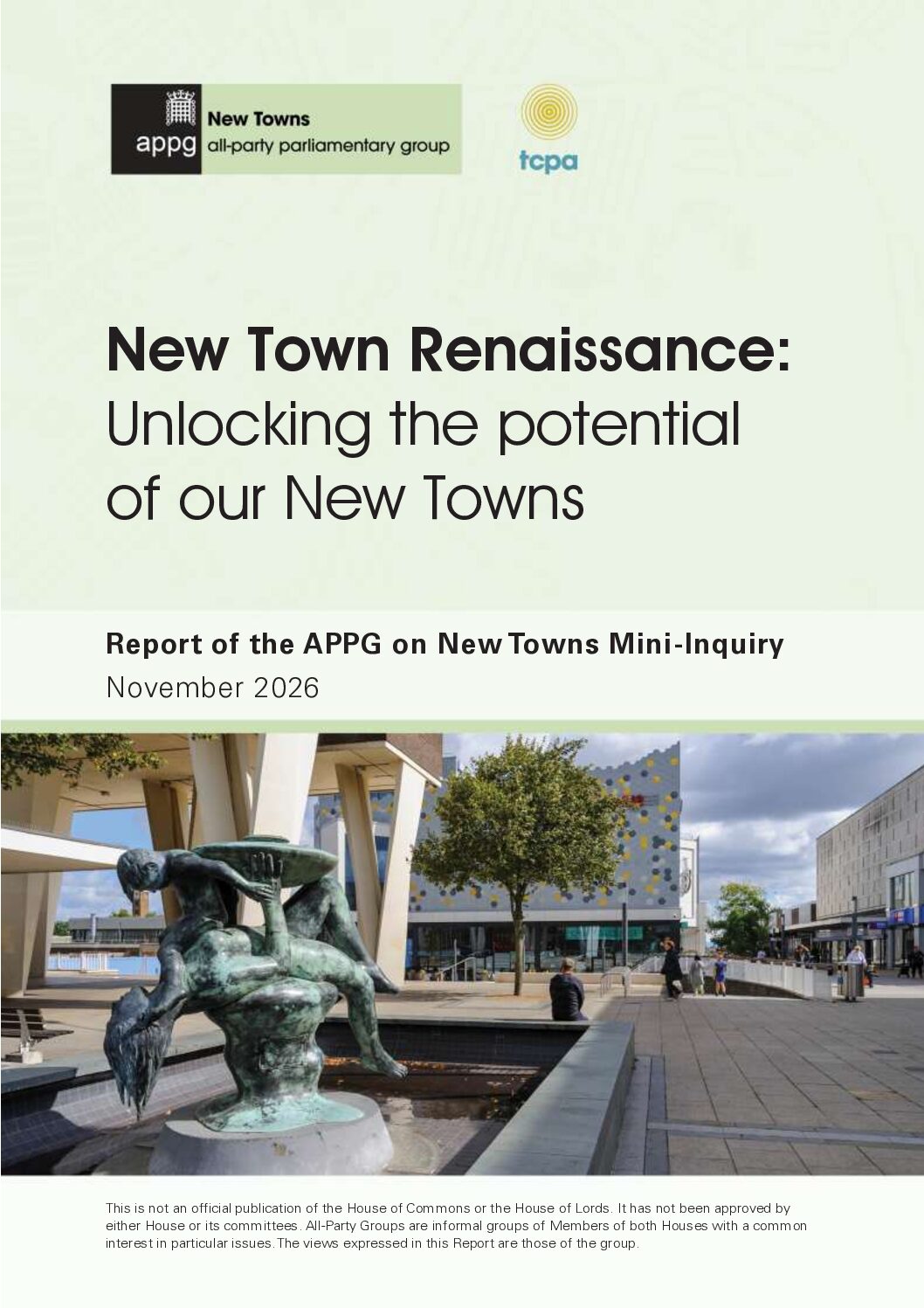
But they are no longer new. This Mini-Inquiry from the All-Party Parliamentary Group (APPG) on New Towns makes the case for dedicated New Town renewal policy and funding, as New Towns should be recognised as having distinct potential and challenges. The report looks at the common challenges they face and how their potential can be unlocked.
The case for New Town renewal
- New Towns remain vital national assets, with major potential to drive economic growth and help tackle the housing shortage, including some of the fastest growing settlements in England.
- From the start, New Towns were designed to evolve. This means they are uniquely placed to support future growth, innovation and stewardship.
- But they face common challenges: New Towns’ town centres and infrastructure are ageing at the same time as each other, and the fire-sale of public assets that took place when the programme ended has led to fragmented land ownership in New Towns.
- There is no dedicated New Town regeneration programme, meaning New Towns find themselves competing for mainstream regeneration funding, despite sharing a common history, distinctive characteristics and a unique set of opportunities and challenges.
Recommendations
These findings reinforce the need for Government to see our New Towns as a distinctive urban policy question and to recognise that their potential and challenges have a very specific character. It calls on the government to:
- Embed Existing New Towns within National Growth and Investment Programmes
- Establish a National New Town Renaissance Taskforce
What the report tells us about New Towns
The report combines new analysis of Census, public investment and local authority data with qualitative research, including interviews with New Town parliamentarians. This includes:
- New analysis on New Town census data about housing, health and relative deprivation
- Case studies of New Town regeneration successes and challenges
- Emerging findings on what leads to successful New Town economic, employment and town centre regeneration
- Findings about how the New Town ambition remains across local authorities and residents, despite a reduction in policy focus on the New Towns
- An emphasis on the importance of retaining that identity across generations
This report draws on research by the Town and Country Planning Association (TCPA), which provides the secretariat to the APPG.
This is not an official publication of the House of Commons or the House of Lords. It has not been approved by either House or its committees. All-Party Parliamentary Groups are informal groups of Members of both Houses with a common interest in particular issues. The views expressed in this report are those of the group.