This new research from the UCL Bartlett School of Planning explores the health impacts of permitted development rights (PDR) converted housing.
As well as mapping hotspots of PDR housing, the research team surveyed over 1,000 residents, making it the most comprehensive analysis of people’s lived experience of PDR housing.
What is PDR housing?
Since 2013, permitted development rights (PDR) have allowed developers to convert offices and shops into housing without full planning permission.
The changes were brought in to try to help tackle the housing shortage in the England. But by removing full planning permission, the policy has led to a large amount of substandard housing, which affects the health and wellbeing of its residents.
Key findings
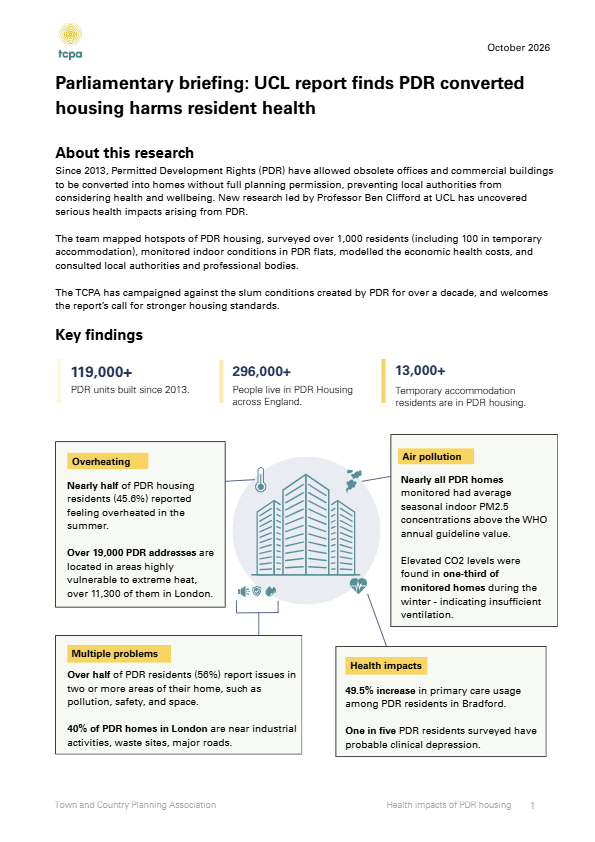
- Over a quarter of a million people live in PDR housing across the England – including more than 13,000 people living in PDR as temporary accommodation.
- 76.5% of residents reported at least one housing problem, such as pollution, poor safety and space, and over half reported multiple issues.
- Nearly half of PDR housing residents (45.6%) reported feeling overheated in the summer.
- PDR housing is linked with worse health outcomes. For example, it reported a 49.5% increase in primary care usage among PDR residents in Bradford.
- 40% of PDR homes in London are near polluted areas like industrial sites, waste sites, major roads
The report calls on the government to remove in its entirety the Town and Country Planning (General Permitted Development) (England) Order 2015 (GPDO 2015), which allows deregulated conversion to residential use. The report calls for it to be replaced with a supportive policy on adaptive reuse of buildings (material change of use) to residential use through the National Planning Policy Framework.
The TCPA have been calling for reform of PDR rules on converted housing since they were first changed in 2013. These PDR rules severely undermine local government’s ability to deliver the healthy homes and communities people need, and cut developer contributions to affordable housing.
We collaborated with UCL in this latest research, alongside the London School of Hygiene and Tropical Medicine and the homeless charity Groundswell, with support from the National Institute for Health and Care Research (NIHR).