
Context
This page was updated in August 2025 in response to the Court of Appeal judgement on the 2023 WMS (see below).
Local planning authorities wishing to set energy efficiency standards for new homes that go beyond building regulations have, in recent years, faced a complex and often contradictory policy context from national government.
The aim of this web resource to is bring together information for local authorities to help navigate this, so they can consider their options in relation to setting policies for net zero homes and buildings within their local plans.
The TCPA’s previous statements on this issue are available to view here (July 2024), and here (January 2024).
Why are local authorities setting planning policies for net zero building?
Many local authorities have developed climate action plans to demonstrate how they will deliver against national and local net zero carbon targets. The planning system provides an important lever to support emissions reductions in sectors responsible for high levels of carbon at a local level, including transport, energy and buildings. Within the context of urgent challenges such as decarbonising transport and retrofitting existing buildings, ensuring that new buildings are built to high standards of energy efficiency (so that they do not rely on carbon for their operation) is an easy win.
However, both existing building regulations, and planned changes through the Future Homes Standard, fail to deliver net zero homes because:
- The methodology for reducing % carbon emissions does not incentivise energy efficiency in buildings as a first principle – meaning new homes can still be built to be draughty and inefficient;
- There is an evidenced ‘performance gap’ with the current approach, meaning that buildings use more energy in operation than the design model suggests;
- The building regulations consider regulated energy only, meaning that ‘unregulated’ energy (from plug loads) is not factored into the energy requirement;
- The Future Homes Standard is reliant on grid decarbonisation, and therefore commits to ‘net zero ready’ homes, rather than ‘net zero’ homes. This is a risky strategy, particularly in areas of high development where grid capacity is already a challenge. Also, as the grid decarbonises, carbon emissions become a less reliable measurement for building performance; and
- Using targets based on % reductions on building regulations creates moving goalposts, as these are regularly updated.
In response, local authorities and a consortium of technical experts (through LETI) have developed an evidenced policy approach using energy based metrics, which are designed to achieve net-zero buildings through securing highly energy efficient buildings and applying an energy hierarchy (so that any residual energy needs are met by onsite renewables). Three local authorities have successfully adopted such policies (Bath and North East Somerset, Cornwall and Central Lincolnshire). Many other authorities (we think up to 70) have invested considerable expertise and resources in evidence to support energy based metrics policies for their local plans.
Bioregional have published a blog which reviews three areas where these policies have been adopted, and finds that they have not hindered housebuilding in these authorities.
Current policy context
13 December 2023 Written Ministerial Statement (WMS)
Published on 13 December 2023, the WMS on ‘Planning – Local Energy Efficiency Standards Update’ replaced the 2015 WMS which was found unlawful through a successful legal challenge (see below). The 13 December 2023 WMS represents current national policy in England, and seeks to constrain local authorities in setting energy efficiency standards that go beyond current building regulations by directing local authorities, where they do set higher standards, to express these ‘as a percentage uplift of a dwelling’s Target Emissions Rate (TER) calculated using a specified version of the Standard Assessment Procedure (SAP).’
Through the inclusion of this, the WMS expresses a preference for policies to utilise the metrics used within building regulations, rather than energy based metrics.
Legal Challenge to the WMS
High Court challenge
In June 2024, a legal challenge against the 13 December 2023 WMS was heard in the High Court. This challenge was bought by community group, Rights Community Action, and supported by the Good Law Project. The challenge was made on three grounds:
- That the minister failed to have due regard to the environmental principles policy statement as required through Section 19 of the Environment Act 2021 when making the policy.
- The WMS seeks to unlawfully constrain powers conferred to LPAs by statute: Section 1 of the Planning and Energy Act 2008 expressly allows LPAs to set energy efficiency requirements that exceed building regulations.
- The WMS also misdirects decision makers in relation to the statutory presumption in favour of the development plan.
The legal challenge was unsuccessful on all three grounds. The court judgement is available to read here.
Court of Appeal
In June 2025, an appeal of the above verdict was heard, and a judgement was passed down in July 2025. The case was dismissed and the judgement is available to view here.
In the court case, the appellant claimed that the 2023 WMS sought to unlawfully restrict the powers given to local authorities by the Planning and Energy Act. However, the Court of Appeal dismissed the claim and maintained that the 2023 WMS represents a sound interpretation of the legislation by setting the parameters under which the government expects the legislation to be applied, namely that ‘a LPA is able to set a local standard up to the level of the draft FHS.’ 1
There are two important aspects of this judgement that local authorities aiming to set net zero buildings policies in local plans should be aware of:
- The Court acknowledged the ‘tension’ between the WMS and the well-established right of local authorities to set policies that conflict with national policy where they are justified.
- The court also underscored the status of the 2023 WMS as national policy and therefore ‘no more than guidance.’2
The 2023 WMS must therefore be understood only as a material consideration for plan making, which does not override the plan making obligation to address climate change. It cannot be interpreted as an absolute direction on the way that local policies must be expressed if evidence demonstrates and justifies a better approach. Therefore, there remains a legal basis for LPAs to divert from the policy approach set out in the WMS, but in practice this would need to be supported by robust evidence and a strong case in order to persuade an Inspector that this was justified.
At the time of writing, the TCPA understands that this case may be subject to further legal challenge to the Supreme Court.
Soon after the judgment was published, the Planning Inspectorate issued a post-hearing letter to West Oxfordshire Council following a reopened examination on the Salt Cross Area Action Plan net zero buildings policies. The Inspector’s letter appears to be in line with this interpretation from the Court of Appeal:
‘I acknowledge that the WMS is a material consideration, but it should also be read in the context of wider national policy and legislative considerations. Reducing carbon emissions and supporting the transition to net zero forms a central part of the Framework2 in line with the objectives and provisions of the Climate Change Act 2008. However, no matter how energy efficiency is proposed to be measured, the environmental outcome, to mitigate climate change and contribute to meeting the net zero obligation, will remain the same. Based on the evidence before me, I conclude the Council’s approach is consistent with national policy.’
The post-hearing letter is available here.
A blog by Bioregional providing further interpretation of this court judgement and its implications for local planning authorities has been published here.
Local authority pre-action correspondence with the Secretary of State
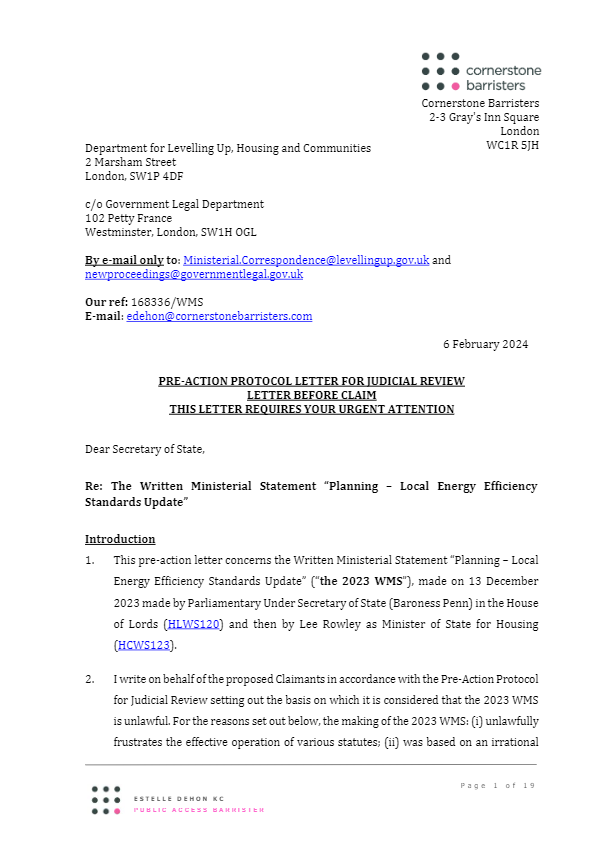
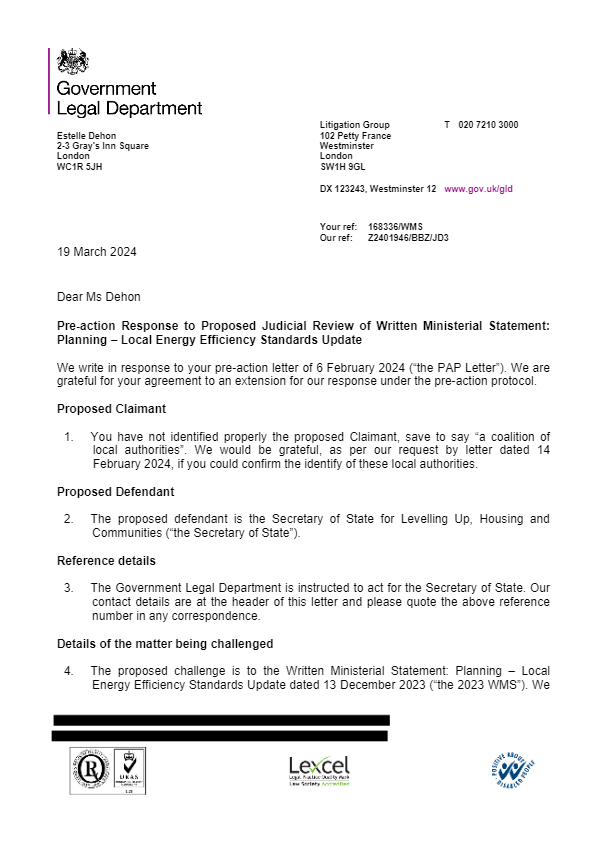
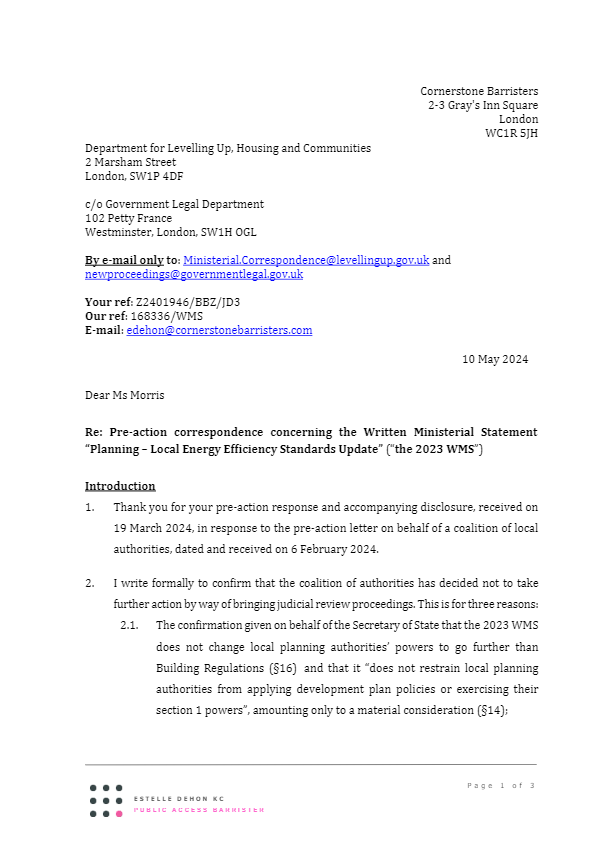
As well as the high court challenge outlined above, a coalition of local authorities also engaged in pre-action correspondence with the Secretary of State regarding the legality of the 13 December WMS. This correspondence is available below, via Estelle Dehon KC, acting on behalf of the authorities (which remain anonymous). The correspondence is helpful because it explicitly clarifies the status and intent of the WMS, which is to be treated as a material consideration, so provides the opportunity for local authorities to set policies that aren’t in accordance with the WMS where local evidence and circumstances justify this. This is explained further in a guest blog for the TCPA and Good Homes Alliance by Estelle Dehon KC, available here.
Pre-action correspondence:
The TCPA’s response to the 13 December 2023 WMS
The TCPA has continued to champion the urgent need for net zero buildings, and the right for local planning authorities to set locally determined building standards through planning, for example by providing a witness statement as part of the High Court legal challenge.
Our guidance on this topic for local authorities is kept as up to date as possible, and aims to provide an honest view of the opportunities for local authorities to set ambitious net zero buildings standards, with awareness of the risk this might entail due to the conflict with the 2023 WMS. This is ultimately a decision for each LPA to be determined by local evidence and circumstances. The TCPA strongly encourages local authorities to be as ambitious as possible in setting building standards recognising that this is vital way of delivering on both their legal and national policy obligations to reduce carbon emissions in line with the provisions of the Climate Act 2008.
Our previous statements on this issue remain available on this webpage:
- The TCPA sent a joint letter, alongside over fifty other organisations and local authorities, to the Secretary of State in February 2024.
- In January 2024, the TCPA published this statement in response to the WMS.
- As well as a short video statement from the TCPA’s Director of Policy, Hugh Ellis:
Open legal advice
Essex County Council have published open legal advice by Estelle Dehon KC at Cornerstone Barristers. The open advice document establishes the legal justification for requiring higher targets for energy performance standards for development than the national baseline and can be relied upon by local planning authorities in open fora, such as public inquiries and local plan examinations.
The following key pieces of advice provide legal justification for local authorities to set energy efficiency policies in local plans that go beyond Building Regulations and use energy metrics. They should be read together.
- Essex Open Legal Advice A (Update May 2025) – Energy policy in plans and Building Regulations (Estelle Dehon KC, Cornerstone Barristers, 6 May 2025)
- Addendum to Essex Open Legal Advices (October 2025) (Estelle Dehon KC, Cornerstone Barristers, 20th October 2025). The short addendum addresses further case law such as the RCA Appeal judgement. It confirms that the 6 May 2025 Advice remains valid and key aspects of the Advice have been reinforced.
Further legal advice published by Etude
Etude is a leading sustainability consultant working with a number of local authorities on their local plan evidence base for climate change mitigation policies. Etude have investigated whether the December 2023 WMS means local authorities can still set higher environmental standards with different metrics than those used in Part L of Building Regulations.
Following legal advice, Etude have found that policies using energy metrics can be bought forward. The legal advice has been made available via this webpage.
Salt Cross Judicial Review and the 2015 Written Ministerial Statement
Prior to the publication of the 13 December 2023 WMS, policies in local plans that set energy efficiency targets beyond building regulations were being treated inconsistently by the Planning Inspectorate. This was because of confusion caused by a previous Written Ministerial Statement from March 2015, the status of which was being interpreted differently by different planning inspectors.
In the case of the Salt Cross Area Action Plan in West Oxfordshire, the Inspectorate’s decision to water down the plan’s net zero buildings policy was successfully challenged by Rights: Community: Action in April 2023.
A copy of the judgement (issued in February 2024) on this case is available here.
Adopted / at examination local plan policies
The table below lists local plan policies that do / seek to include energy efficiency standards that go beyond building regulations, to direct other LPAs to relevant examination documents. Note that some of the policies listed here were adopted prior to the publication of the 2023 WMS.
If you are aware of another relevant example to add to the table please email us at tcpa@tcpa.org.uk
| Local Authority | Plan Status | Examination Date | Link |
| Bath and North East Somerset | Adopted | December 2021 | The Local Plan | Bath and North East Somerset Council (bathnes.gov.uk) |
| Central Lincolnshire | Adopted | July 2022 | Local Plan for adoption Approved by Committee.pdf (n-kesteven.gov.uk) |
| Cornwall | Adopted | June 2023 | Cornwall Climate Emergency DPD |
| Greater Manchester | Adopted | February 2022 | Places for Everyone (greatermanchester-ca.gov.uk) |
| Merton | Adopted | December 2021 | Local Plan submission and examination library | Merton Council |
| Tendring Colchester Borders Garden Community | Adopted | July 2023 | Creating a Place for Life (tcbgardencommunity.co.uk) |
| West Berkshire | Adopted | March 2023 | Examination of the West Berkshire Local Plan Review 2022-2039 – West Berkshire Council |
| Salt Cross Area Action Plan | Examination | Summer 2025 | Post hearing letter: here |
| Uttlesford | Examination | Summer 2025 | Post hearing letter: here |
| Winchester | Examination | Summer 2025 | Winchester Local Plan Examination |
| Enfield | Examination | Summer 2025 | New Enfield Local Plan | Enfield Council |
If you would like to receive updates on this policy topic, please email celia.davis@tcpa.org.uk to request being added to our mailing list.