Read the second blog in this series: Can we see the woods from the concrete?
Efforts to ensure that planning systems in England and Scotland contribute to nature recovery are frustrated by a complex array of operational and technical barriers. This was a clear message from a series of recent practitioner focus groups, which show a host of challenges that are symptomatic of the lack of priority given to nature in the planning system.
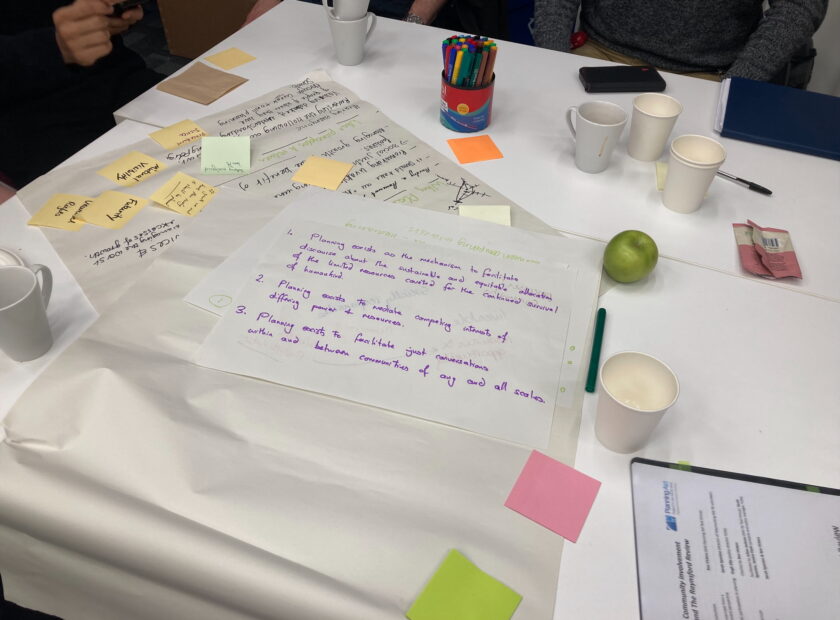
Four focus groups were held in Autumn 2025 with planning and ecology practitioners involved in local government, national policy and the development and biodiversity sectors. The focus groups were delivered by the TCPA as part of the Planning for Nature project funded by the Economic and Social Research Council. Led by the University of Sheffield, the research is a two-year project to investigate the effectiveness of English and Scottish planning policies at the interface between housing development and biodiversity.
The focus groups provided an opportunity to explore with practitioners how current planning policies and practices are engaging with the urgent need for nature recovery. This is the first of two blogs that draws out the key themes from those conversations.
Practical complexity
The conversations revealed how practitioners are operating in a startlingly complex and constantly shifting system, the effectiveness of which is compromised by chronic under-funding and under-resourcing. This context, alongside operational and technical challenges, hamper the ability of local authorities to secure good outcomes for nature through planning policies and decisions.
A clear example of this is the introduction of Biodiversity Net Gain (BNG) in England. Participants spoke at length about the significant challenges of developing and implementing BNG locally, in the context of very limited resources and competing priorities. Despite this, some shared encouraging views that BNG was beginning to shift developer behaviour, especially by forcing applicants to consider biodiversity impacts and mitigation much earlier in the planning process.
Yet many were equally dismayed at the uncertainty created by the government’s consultation on widening exemptions to BNG, only a year after its launch, alongside the simultaneous introduction of Environmental Development Plans through the Planning and Infrastructure Bill as another contiguous mechanism for addressing environmental harm from development.
As one participant noted:
There are gaps, there are failings, there are restrictions and limitations … and there’s just a myriad of different acts of parliament and regulations which you have to navigate through, and the difficulty of just trying to sort of work out which law applies here, there and everywhere…. There’s just so much coming in and it’s not joining up.
Mind the gap
The BNG experience in England provided some contrast to the Scottish experience, where no comparable metric-based system currently exists. In Scotland, nature recovery features much more prominently in the National Planning Framework 4 than it does in the NPPF in England. However, the focus group discussion with Scottish practitioners revealed challenges in implementing high level policy aspirations:
The Scottish Government is really good at these national strategies, and we have got these fantastic policy goals. We’ve got the 30 by 30, we’ve got nature networks, we’ve got these big ideas for both protecting existing nature and for creating new nature.
Focus group participant
But I think there’s always the delivery thing. Who is doing it? How is it funded? And how do things link together? And this is a consistent weakness in the Scottish Government approach.
In England, participants reflected on the opportunities presented by the introduction of Local Nature Recovery Strategies (LNRS), with a handful now published. Although a clear potential was identified here, especially if integrated into new spatial development strategies, it was noted that there remained significant uncertainty about their weight in planning and further complexity around institutional responsibilities.
Several participants in England expressed hope that a return to strategic planning – primarily framed as ‘larger-than-local’ – would help smooth over knotty trade-offs experienced at a much more local level between economic growth and housing delivery and nature protection.
Yet as the focus group in Scotland showed, setting nature strategies at a higher scale and with a wider canvas cannot magically alter the imbalances entrenched in the planning system and the resourcing of different functions, which stymie effective implementation and favour private development interests. Rather, it changes the forum where decisions are taken, away from the local, with important implications for democratic participation and accountability.
Onsite vs strategic delivery
There was an underlying tension in the focus groups over the shift from the traditional role of the planning system in defending local biodiversity and habitats to a new approach based on strategic offsetting. This related in part to debates about on and offsite BNG offsets, but also took on added resonance as the focus groups took place as opposition to Part 3 of the Planning and Infrastructure Bill (PIB) was mounting, with many participants airing frustration at the government’s positioning of nature as a ‘blocker’ to development.
Concerns were raised about the PIB’s ‘strategic approach’ of Environment Delivery Plans and the Nature Recovery Fund, which will allow developers to pay a levy to offset anticipated environmental harms rather than mitigate the development’s specific impacts on habitats and protected species. These worries included a perceived move away from the mitigation hierarchy, the ‘burden shifting exercise’ from the private to the public sector and weakening of onsite assessments. A surprising aspect of this discussion was that the strongest voices in opposition to the PIB came from parts of the private sector.
These views were not universal, and some participants supported the direction of travel to a more strategic approach to nature recovery, feeling that mitigation approaches can at times lead to perverse outcomes that push significant resources to the wrong places (the HS2 bat tunnel was offered as an infamous example). The strategic advocates in the group felt that local onsite delivery did not address the root causes of nature’s decline, such as agriculture and land management, which require broad solutions and investment.
The shift to more strategic offsetting, whether through BNG or EDPs raised three overarching issues amongst the focus groups. The first is a concern from practitioners that offsets delivered offsite create poorer outcomes and are riskier in terms of delivery, and secondly that offsite delivery can be distant from the development site and therefore provide very limited benefit to the communities affected by development. The third related issue is that offsetting funds will used at a strategic level on sites determined by a technocratic process, again funnelling benefit away from the places most affected by the original development. That may risk breaking people’s everyday emotional and spiritual connection with nature and harming their health and quality of life.
In reality, the debate presents a false dichotomy, and the planning system should be equipped to deliver gains for nature both onsite and at the strategic scale.
As one contributor put it:
There shouldn’t be a focus on one versus the other. It should be where it’s needed. It should be where there’s evidential need for nature to function, for people.
Worryingly, the focus groups paint a picture of a system failing to do either. Both BNG, EDPs and the Nature Recovery Levy depend on being able to monetise the value of nature and then create opportunities to mitigate or offset those impacts, but often through highly complex technocratic systems. These were being operated without proper resourcing of local authorities, undermining its capacity to deliver for nature.
The experience in Scotland has also shown that high level ambition for nature recovery must be matched with delivery tools to secure better outcomes on the ground. Within the current planning regime, meaningful delivery for nature risks falling through the gaps.
A second blog reflecting on these focus groups will be published next week. This will take a deeper look at the systemic challenges restricting our ability to plan for nature, and the gap between political rhetoric and action on the ground.
You can find out more about the Planning for Nature project here: https://www.planningfornature.org/