
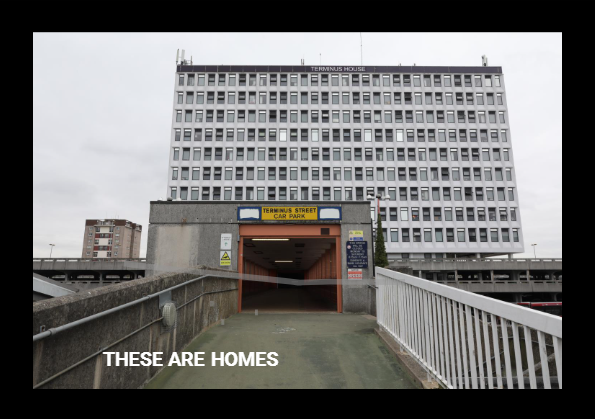
The delivery of poor-quality new homes has been facilitated by Permitted Development rule changes in the last ten years. Initially, Permitted Development was used to allow minor extensions to homes and buildings without requiring a full planning application. Since 2013, these rules have been extended to allow a wide range of buildings (including offices and light industrial warehouses) to be converted into flats and other uses without needing to go through a planning application.
The aim of these rule changes was to increase the number of new homes, but the quality of those homes was never a consideration. Over 119,000 homes have been created through Permitted Development since 2013. The poor quality of many of these conversions reflect the lack of strong and clear standards, with many people living in damp, cramped, noisy, unsafe and isolated properties.
Permitted Development undermines the ability of local authorities to shape good quality place-making through the democratic planning system, which is essential to protect and support people’s health. For example, by avoiding a full planning application, developers do not need to meet ‘section 106’ requirements to contribute towards affordable housing and community amenities.
There is no requirement to address key building regulations in homes produced through a ‘material change of use’ under Permitted Development. As part of our Campaign for Healthy Homes, the TCPA has identified 12 Healthy Homes Principles that all new homes must achieve. These include ensuring fire safety and safety from crime; accessibility, adaptability and inclusion; adequate living space; thermal comfort and energy efficiency; climate resilience to risks like flooding and overheating; prevention of air, noise and light pollution; and access to local amenities and green spaces. Just one of these principles – the provision of liveable space – are addressed by current Permitted Development rules, and even then, the space standards are poorly defined for babies and children.
The TCPA is working with UCL as part of its ‘Health impacts of converted housing’ project, funded by the National Institute for Health and Care Research: The UCL Permitted Development Converted Housing Project.
You can find out more about Permitted Development below.
News, evidence and blogs
- Hot Housing: Why is the government still permitting overheated office conversions? (May 2026)
- Permitted development to support the provision of new homes: Scottish government consultation – TCPA response (Oct 2025)
- The category error of planning deregulation – New Statesman (Sept 2025)
- Housing conditions in England – TCPA response to HMLG Committee inquiry (Aug 2025)
- Permitted development rights, health and housing: UK parliamentary briefing (Dec 2024)
- Changes to various Permitted Development Rights: TCPA response to latest government consultation (April 2024)
- Quick office-to-housing conversions will risk residents’ health, according to new TCPA research (Feb 2024)
- Expanding Permitted Development Rights: TCPA response to government consultation (2023)
- The impact of planning deregulation on rural economies – blog by Lord Taylor of Goss Moor (Oct 2024)
Research and evidence
- Permitted development, housing and health: a review of national policy and regulations (TCPA, 2024)
- Our Fragile High Streets – Death by Permitted Development Rights? (TCPA, UCL 2021)
- No place for placemaking (TCPA, 2020)
- Assessing the impacts of extending permitted development rights to office-to-residential change of use in England (RICS and UCL, 2018)
- Research into the quality standard of homes delivered through change of use permitted development rights (MHCLG, and UCL, 2020)
Further resources: