Jeanette Aves shares reflections on the workshop: Planning is dead. Long live planning. Renewing the Purpose of Planning
At the TCPA, we work to realise the transformational potential of planning. This shouldn’t be controversial for a sector founded in the public interest. But among seemingly unlimited planning cuts, deregulation and viability tests, our work has felt increasingly isolated.
So, when we gathered 50 planning practitioners, researchers and students and asked them to consider the purpose of planning, we were reassured not to hear the words more GDP growth. Instead, conversations focused on equality, sustainability, and social, health and community justice. These views struggle alongside growing despair in the profession and it’s time we stand up to the narrative of planning as a blocker to progress. Planners have fought for the public interest in development for 100 years and they’re not done yet.
So, how can we renew the purpose of planning?
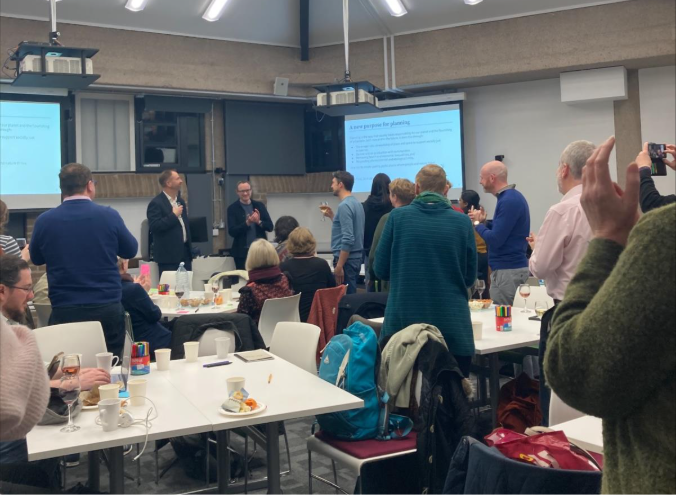
Image: Declaring the co-produced new Purpose for Planning* enshrined in the declaration
‘There has been a singular lack of forums for debate, certainly amongst the planning profession, about the principles of planning.’‘ Malcolm Tait, University of Sheffield
With/for people (democracy and public perception)
If I was to take one conclusion from the day, it would be that planning is working less and less in the public interest and we have to put that right.
Overwhelmingly, the workshop recognised negative public perceptions of the planning system as a major challenge. This is exacerbated by a ‘power imbalance’ in decision making, where the resources of the development sector and the application of viability tests undermine local aspirations on issues such as amenities provision, affordable homes or action on climate change1,2. Media misinformation and constant references to ‘red tape’ further fuel public mistrust. Recent RTPI surveys indicate 85% of planners believe the public view the planning system as a hindrance, rather than a benefit (Planner Careers Survey 2025, The Planner and RTPI).
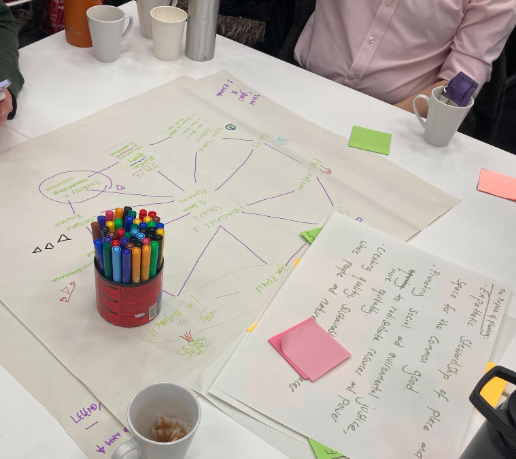
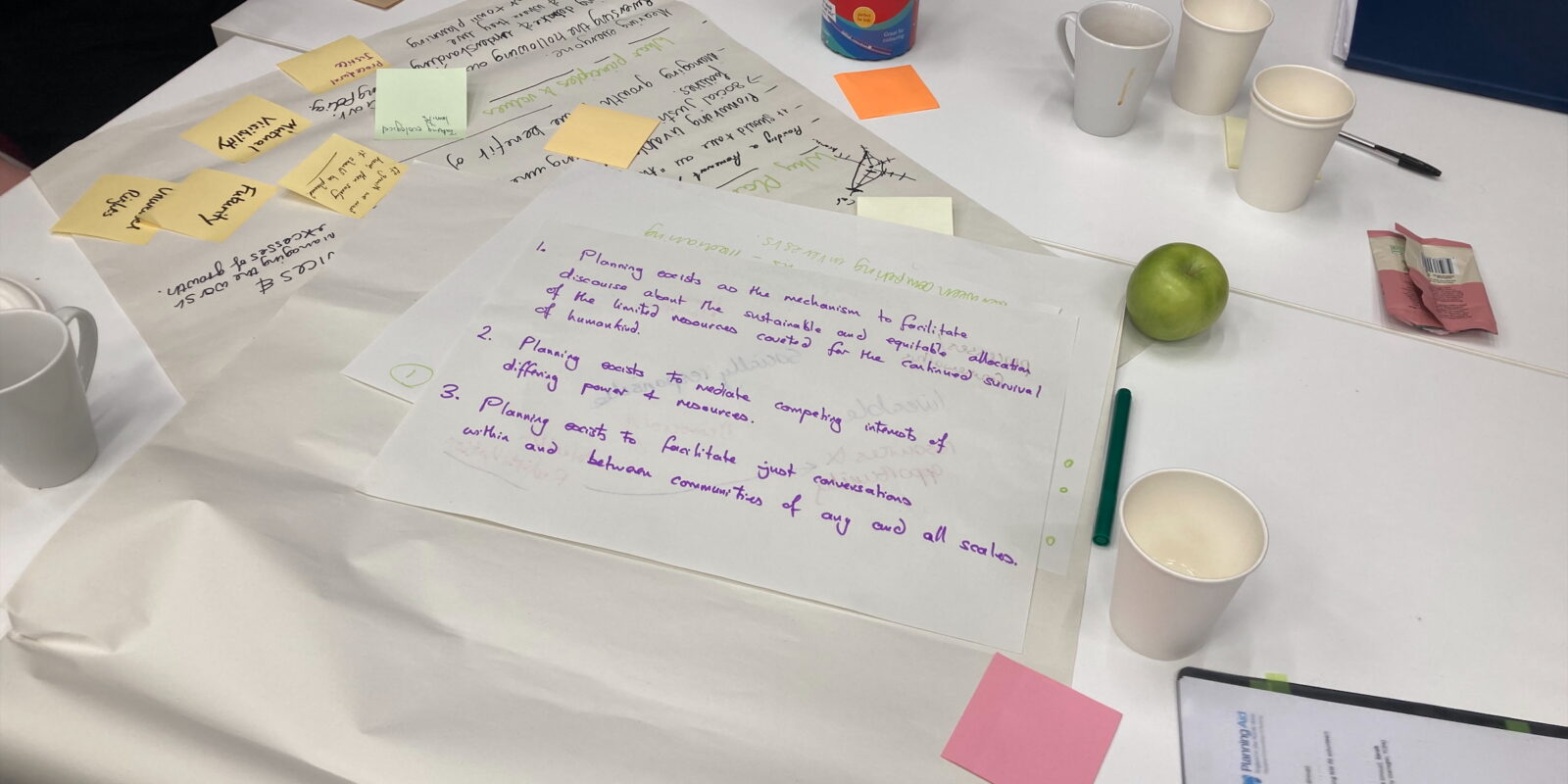
Image: Mapping out challenges for planning at the workshop
‘We’re offered a convenient narrative: planning as delay, inefficiency, and obstruction.‘ Anna Rose, Head of the Planning Advisory Service (PAS)
Planning for public good (health, equality and social justice)
It was shocking how many attendees felt the planning system isn’t currently working in the public interest. From notes on the ‘privatisation of public purpose’, to the ‘tyranny of growth’, it was evident that metrics such as housebuilding numbers are being prioritised over quality of place. These undermine both the needs of current and future communities. University of Sheffield findings offer similar conclusions: that planning merely polices interests in land management, too focused on entrenched processes, targets and delivery3.
The role of planners in understanding and reflecting the everyday experiences of communities has been undermined. This calls for more meaningful public participation. The approach that was suggested most was co-production: to be used both with communities and other sectors. And this would need to be supported by clear, transparent communication and a commitment to listening to others. Together, these could build legitimacy and rebuild mutual respect in the planning system.
Planning for public good also touches on the recurring concern of climate change. If we are to build for future generations as well as ourselves, greater attention needs to be paid to flood risk, overheating and zero carbon construction. These are foundational to sustainable development and should remain strongly in the foundations of new proposals.
‘The housing that’s being built isn’t for the people who need it’. Workshop attendee
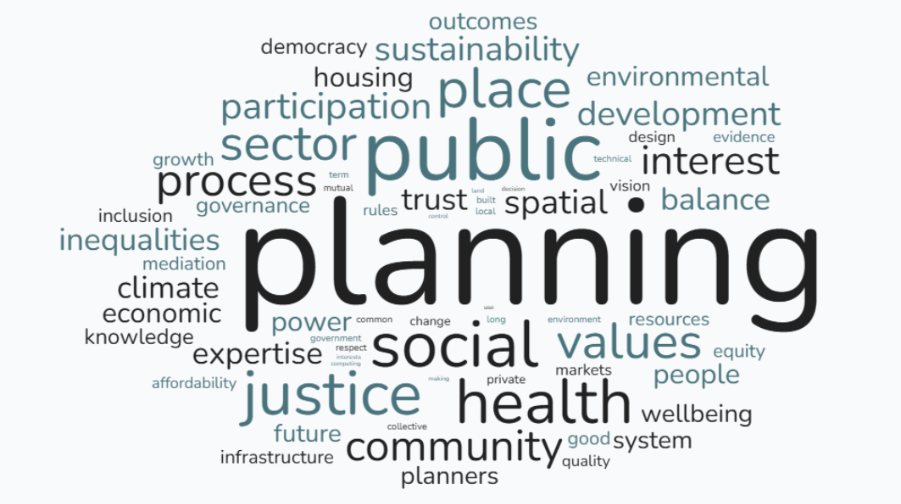
Image: A word cloud of the most common words proposed by participants when describing what planning should be for. The most common (in order) are: ‘place’, ‘public’, ‘values’, ‘social’, ‘health’, ‘justice’, ‘process’, ‘community’, ‘participation’ and ‘sustainability’.
‘The austerity planner’s career is marked by proceduralism, and they often have little opportunity to think about the public interest’ RTPI 4
Call to action!
The workshop in Sheffield exposed serious concerns that planning has lost its way. But it also united calls for hope. A hope that planning could reignite its primary purpose to deliver in the public interest. And this was seen in the principles and values identified as underpinning it.
But reigniting this purpose requires a tone shift. A shift away from deregulation, constant change and inadequate resourcing. Towards planners being prioritised as co-producing with their community. Towards planners actively guiding planning proposals, rather than being constrained to box-ticking.
These changes aren’t easy, but they are achievable if we change the narrative. The Sheffield Declaration is our first step towards this. Join us in our campaign and sign the declaration.
References
1 https://www.theplanner.co.uk/2025/11/03/development-viability-and-planning-social-justice
2 66% of public sector planners say their teams lack the capacity to meet demand: https://www.rtpi.org.uk/new-from-the-rtpi/state-of-the-profession-2025
3 https://discovery.ucl.ac.uk/id/eprint/10113579/1/WITPI_WhatMustPlannersDo.pdf
4 https://www.rtpi.org.uk/media/iqaitjyi/servingthepublicinterest2019.pdf
Note: All unreferenced quotes are from the workshop.
A New Purpose for Planning
The workshop culminated in the co-creation of a new ‘purpose for planning’ statement.
Planning is the way that society takes responsibility for our planet and the flourishing of all people, both now and in the future. It does this through:
- The empathetic stewardship of place and space to support socially just outcomes
- Democratic co-production with communities
- Removing health and economic inequalities, and
- Respecting environmental and ecological limits,
in order to create quality, joyful places where people and nature thrive.