Image credit: Make Architects
A London Olympic Legacy housing development, designed with the needs of young and intergenerational families at its core.
The rationale for taking a child-friendly approach
Chobham Manor is the first completed neighbourhood delivered as apart of the Queen Elizabeth Olympic Park legacy. Situated in Newham, one of the youngest and most diverse boroughs in London, it was developed to set a new benchmark for inclusive urban neighbourhoods.
The design approach focused on setting the conditions that could support long-term stability for this new community. Geared towards families, 75% of homes offer three bedrooms or more, including some five-bedroom townhouses to support multigenerational living. All properties exceed national space standards allowing residents flexibility with their homes over time. The neighbourhood is 35% affordable housing (the Mayor’s target at the time).
Delivered by Taylor Wimpey with London & Quadrant (L&Q) under the stewardship of the London Legacy Development Corporation (LLDC), Chobham Manor was completed in four phases (2015-2022). The scheme aimed to show how large-scale development can integrate family life, community infrastructure and high-quality public realm in a dense urban context. The scheme challenges the community transience historically experienced in this part of London, instead offering generous housing typologies and daily-life infrastructure to support residents to put down roots.
The scheme challenges the community transience historically experienced in this part of London: generous housing typologies and daily-life infrastructure support residents to put down roots.
The planning and design process
Chobham Manor was the first of the Olympic legacy neighbourhoods to be delivered, guided by a clear vision, masterplan and inclusive design standards. The LLDC’s ambitions were shaped by the 2012 Games’ goals to be the most sustainable and inclusive ever, and this ethos is evident in the development’s layout and features.
The housing mix includes a combination of owner-occupied and rented homes, although residents note that social rented properties on the estate are still relatively expensive, though this is due to factors beyond the development itself.
Chobham Manor’s close proximity to exceptional public transport, including Stratford and Stratford International stations, is a key benefit to residents offering reasonably affordable and easy access to jobs and education both near and further afield. The Queen Elizabeth Park is also on the doorstep of residents, providing access to world class sports and leisure facilities.
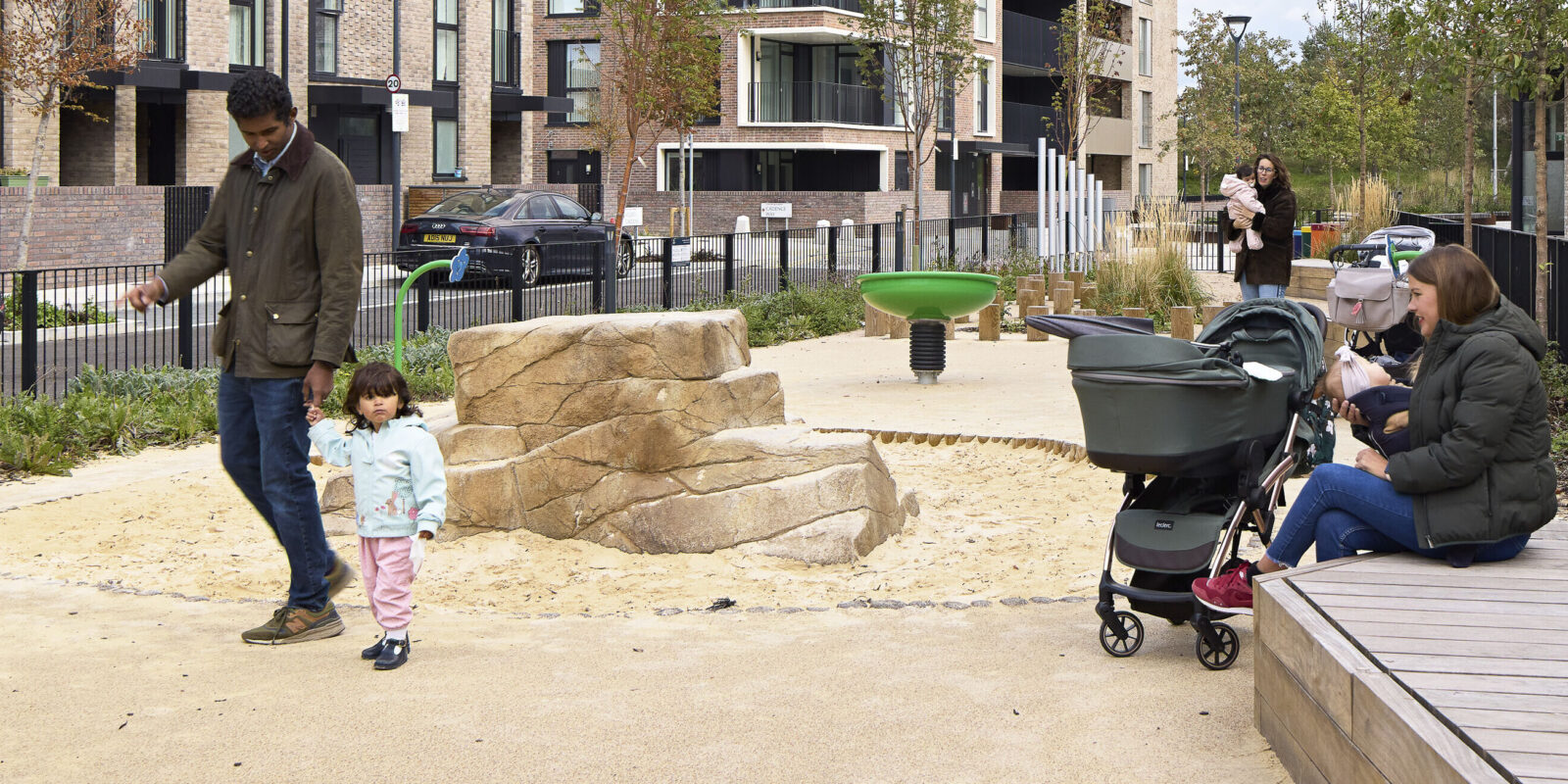
The development layout is built around a central ‘ribbon’ of green and playable space, overlooked by homes and designed to support informal, everyday use.
The development layout is built around a central ‘ribbon’ of green and playable space, overlooked by homes and designed to support informal, everyday use. The neighbourhood layout has been influenced by the traditional London pattern of streets and squares, with a range of different homes provided, from mansion blocks to terraces and mews.
All the homes are well-sized, feature generous storage and are within walking distance of schools, a healthcare centre and local shops. The estate’s paths and roads are designed for shared use, or feature other traffic calming measures. Public realm and play features were supported by early input from play specialists, with a clear emphasis on creating spaces that feel safe, accessible and inviting for young children.
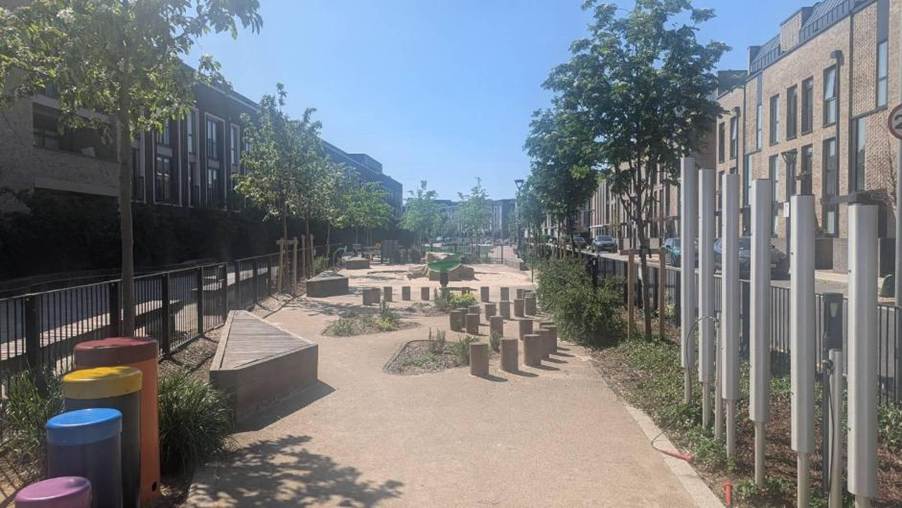
Part of the play ‘ribbon’ running through Chobham Manor. Credit: A Place in Childhood
Community feedback and use
Feedback gathered by A Place in Childhood during a site visit, and discussions with the Residents Association, confirmed that the central ribbon of play space is one of the most valued aspects of the development. These spaces are used extensively by young children and their families, especially as an after school gathering place, and the overall layout is seen as supporting safety, supervision and sociability. A Post-Occupancy Evaluation carried out in 2022 also notes that residents of Phase 1 feel that the development is family-friendly, describing that they live in a place that is ‘[situated] in London but with the feel of a small town.’
However, some parents/carers and residents noted that the play provision, while well-maintained and widely used, is relatively prescribed. The lack of more open-ended play opportunities, such natural landscaping or loose parts, means there is less scope for creative or imaginative play. In addition, while there are large public art installations in the wider area (some designed with input from young people), the estate includes little that actively invites older children and teenagers to gather or play informally.
The lack of more open-ended play opportunities, such natural landscaping, means there is less scope for creative or imaginative play.
There is a sense that as current cohort of young families grow up, the neighbourhood may feel less well-suited for teenagers unless further facilities are introduced. There is wider provision in the Queen Elizabeth Park for older children and young people but this requires travel beyond the estate by walking, wheeling and cycling.
The community itself is active and engaged. The Residents Association play a strong role in supporting local improvements, advocating for residents, seeking clarity on changes to the estate and fostering a sense of connection and belonging. The community centre is widely appreciated as a key neighbourhood anchor. Run on a not-for-profit basis by an organisation supporting people with learning disabilities, it sits at the heart of the development and contributes significantly to its inclusive character.
The community centre is widely appreciated as a key neighbourhood anchor.

A sign made with children for the very popular Rain Garden. Credit: A Place in Childhood
Reflections from development stakeholders
Insights from development professionals highlight how the LLDC’s strong leadership and long-term vision were instrumental in delivering a project of this kind, especially over multiple phases. By insisting on higher standards for housing size, layout and tenure mix as well as retaining oversight throughout delivery, the Corporation enabled the realisation of a development model not typically prioritised by large housebuilders. Good relationships and a sense of shared purpose helped all parties work together cohesively to deliver Chobham Manor successfully.
Nonetheless, there were trade-offs. Some intended play and landscape features were lost due to value engineering. Also while the design is widely seen as successful for families with younger children, its limited provision for older age groups remains an area for improvement. LLDC has taken these key learnings from Chobham Manor to inform the briefing and masterplans for subsequent neighbourhoods in the Park.
Learning for other places
Planning and design
- Design for long-term living and local demographics: Chobham Manor shows how generous space standards, walkable access to services and a mix of housing typologies can support residents to stay rooted in place.
- Family-friendly neighbourhoods can be dense: With the right public realm, density need not compromise quality of life for families and children.
- Play should span the age range: The development excels in offering spaces for younger children but lacks provision for older children and teenagers. This could be enhanced by having features to climb, swing on, or social seating that is welcoming and well-lit for teenagers.
- Prescribed play has limits: Fixed equipment and formal layouts are widely used but may not encourage more imaginative, messy or creative play. Adding loose parts, natural elements or informal zones could improve inclusivity.
Management and maintenance
- High-quality maintenance enhances pride: Private cleaning and maintenance arrangements ensure the estate remains clean and inviting. While this is not uncommon in London, affordability and culture may mean this arrangement is hard to replicate in other places.
- Community anchors matter: The not-for-profit community centre is deeply valued and helps build social infrastructure that formal design alone cannot deliver.
Strategic framing and replicability
- Public sector leadership enables quality: The LLDC’s model shows how a strong public-sector client can secure better-than-market outcomes by controlling delivery and setting the agenda.
- Replication requires investment in competency: To deliver similar results elsewhere, local authorities and delivery bodies must invest in the skills and structures needed to manage complex developments and retain control over quality. This enabled the handling of risk with greater confidence, as well as supporting an overall sense of design quality across a scheme.