As the consultation comes to end on a new plan for England, it’s time to put the creative voice of communities back into the system with a new chapter 21
Effective community participation is the foundation of a successful and stable planning system. People should have a right to shape decisions in their localities. Crucially, that involvement leads to improved outcomes which can help rebuild civic trust by better meeting the needs of the community.
In a system underpinned by representative democracy, promoting community participation is not the same as creating a veto by one social group on development that is vital for the public interest. Instead, it is about promoting a process of co-creation in which the community understands their responsibilities to, for example, create a sufficient supply of socially rented homes, and where developers and planners genuinely respect and listen to the aspirations of the community.
The ultimate success of the Government’s planning reform agenda depends entirely on whether communities regard the system as fair and legitimate.
The ultimate success of the Government’s planning reform agenda depends entirely on whether communities regard the system as fair and legitimate. If they don’t, then we will see the kind of backlash which brought down the 2004 reform package which had an effective life of less than five years. The sense of planning ‘not listening’ to people has created a grievance which has been exploited by populist politicians. This has been exacerbated by the reality that current planning reforms will reduce genuine community participation and centralise decision making by, for example, the exclusion of public right to be heard in the new regional plans and the implementation of a national scheme of delegation.
The sense of planning ‘not listening’ to people has created a grievance which has been exploited by populist politicians.
Excluding people from planning decision is not just bad politics. It is not justified by the evidence. The Raynsford Review of Planning in England, which was published in November 2018, found no evidence that community participation adds to delays in the planning process. The citizen has tightly bounded opportunities to engage in decisions framed in secondary legislation which, for planning applications, gives them only 21 days to respond. For local plans there are only two six-week consultation periods. This has to be taken together with the profound asymmetry in the power and resources between communities and the private sector.
The Raynsford Review of Planning in England (2018) found no evidence that community participation adds to delays in the planning process.
The current draft version of the National Planning Policy Framework (NPPF) has only brief references to community engagement and no references to ‘public participation’. That matters because ‘participation’ is defined in the literature as a process in which power is shared in a genuine process of co -creation. The current wording of the draft NPPF creates no sense that public participation should be prioritised as a way of rebuilding trust with communities.
Previous national policy went much further in advocating community participation and offered guidance as to how it should be achieved[1]. Whilst there is some limited advice on community engagement in the government’s draft design guidance, there is nothing in the NPPF which might indicate how this should be prioritised or implemented in either development planning or development management.
The TCPA is recommending that the final version of the NPPF contains a new chapter 21 specifically focused on prioritising community empowerment.
As a result, the TCPA is recommending that the final version of the NPPF contains a new chapter 21 specifically focused on prioritising community empowerment. This chapter includes policy to prioritise participation in the planning process as part of the planning system’s wider priority to deliver on the United Nations Sustainable development goals. The chapter includes measures to positively support the many community-led initiatives which are vital to social sustainability and so promoting social justice and reducing inequality.
You can support the call for a new Chapter 21 by submitting the text below to the Government’s consultation on the NPPF which you can find here: NPPF consultation (gov.uk)
A new chapter 21 of the NPPF
21 People and Planning: the Government’s Objectives
The objective of the policies in this chapter is to ensure that people are at the heart of the planning process in order to produce improved planning outcomes that meet the needs of England’s diverse communities. It aims to embed the voice of communities in all parts of the decision-making process and to harness the enthusiasm of local communities to drive local solutions which can support community resilience and civic renewal. This chapter aims to secure public participation in all parts of the development plan and development management process in order to:
- Deliver outcomes that better reflect the views and aspirations of the wider community in all its diversity.
- Promote social cohesion and social justice by making real connections with communities and offering them a tangible stake in decision making.
- Encourage vibrant open and participatory democracy in which the citizen has right to be involved.
- Improve the quality and efficiency of decisions by drawing on local knowledge and minimising unnecessary and costly conflict.
- Prioritise meaningful co-creation in decision making that educates all participants about the needs of communities, the business sector and how local government works.
Plan Making Policies
PP1 Supporting community participation
Plan makers should prioritise community participation in the preparation of development plans in order to ensure that people:
- Have access to honest and accurate information at the earliest possible stage of decision making so they can understand the context. There is a statutory framework for making information available which acts as minimum standard, but plan making bodies should have a communications strategy which exploits both traditional and digital media to reach out to those who do not normally participate.
- Can participate in an ongoing and meaningful dialogue throughout the plan making process through mechanisms such as advisory panels and citizens’ assemblies.
- Can take an active part in co-creating development proposals and options. It is not enough to focus on providing information and consultation on proposals that have already been developed to the point where it is difficult to take other views on board. The community must be able to put forward and debate options and help mould proposals before they are settled. This means that councillors, developers and planners have to be ready to listen and to adapt their own ideas.
- Can comment on formal proposals including being able to object and having a right to be heard in the plan making process.
- Can get feedback and be informed about the progress and outcomes of a planning decision.
PP2 Understanding communities
Plans should be informed by an up-to-date understanding of the diversity of the local community. Participation cannot happen without a good understanding of the makeup, needs and interests of all those different groups and their capacity to engage. An inclusive approach is needed to ensure that different groups have an opportunity to participate and are not disadvantaged in the process. Some of these groups will be well established and represented.
In other cases, however, interests may not be organised and therefore be less able to engage with the formal processes of planning. Some groups, such as children and young people, are particularly disengaged with the planning process. Consideration should be given to how people are most likely to get involved and what facilities are available to them. Identifying and understanding the needs of groups who find it difficult to engage with the planning system is essential.
PP3 Promoting social sustainability through community led development
Development plans should positively support the aspirations of community organisations to deliver a wide range of initiatives from local energy projects, cooperative housing, local food growing and climate resilience projects which all have a proven track record in generating significant community benefits. These benefits include tackling social exclusion, reducing loneliness, increasing skills and entrepreneurship and providing a wider sense of positive civic renewal. Plan makers should actively seek to encourage such projects where they can demonstrate genuine public benefit, through specific local plan site allocations and supporting policy. The development plan should identify, at the most appropriate level, land for:
- Community led housing initiatives.
- Community led local food growing initiatives on a permanent or temporary basis including on micro sites.
- Community energy production including onshore wind.
- Community led flood resilience and rewilding initiatives designed to absorb water and slow the flow in vulnerable catchments.
[1] Community involvement in planning: the Government’s objectives. Office of the Deputy Prime Minister, 2004
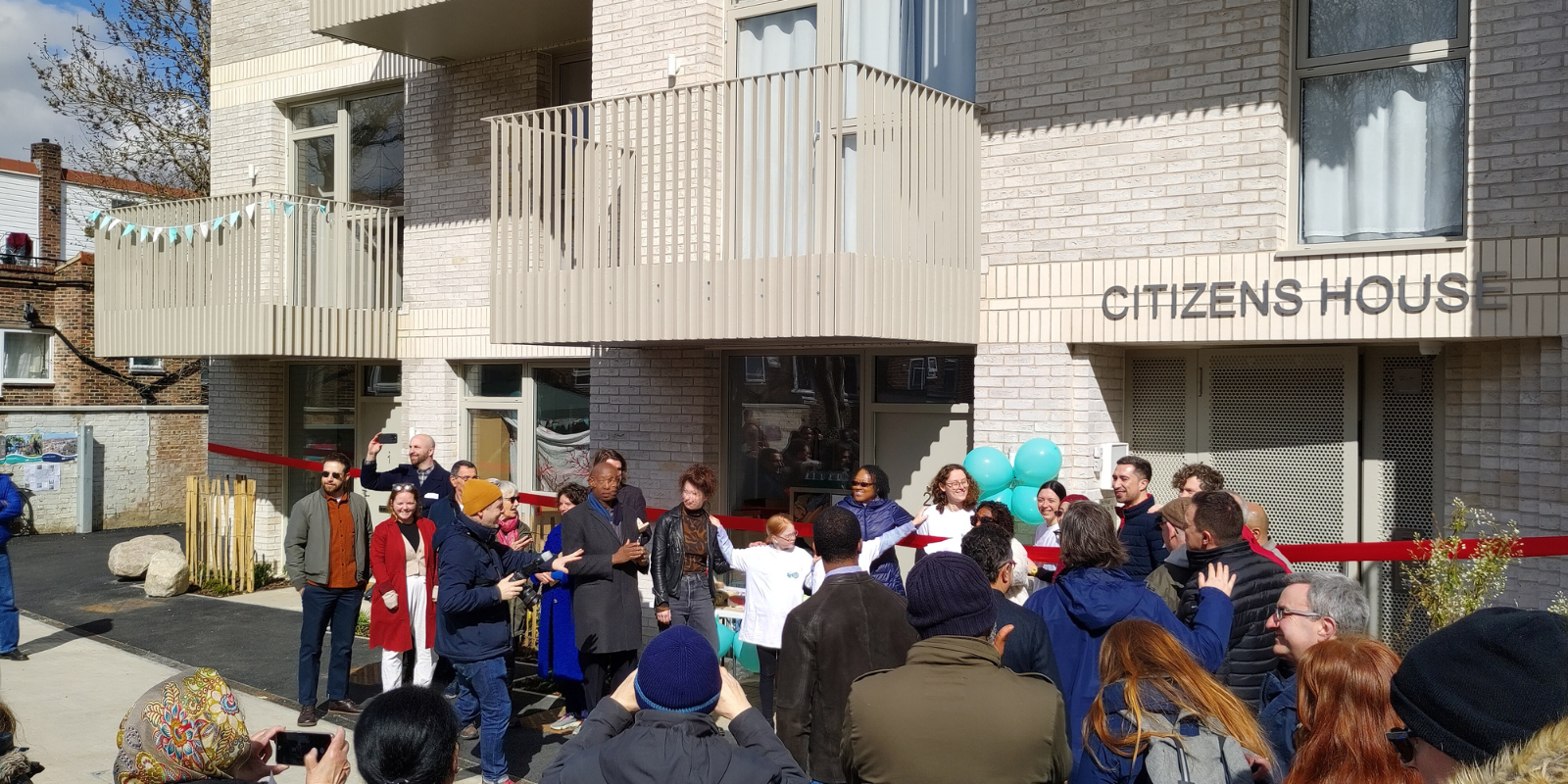
Header image: Residents and neighbours celebrating the opening of Citizens House in Lewisham. It is the first community land trust in London that has been directly created by the community.