On Monday 12 October, we held our 15th Annual Osborn Memorial Lecture, and this year it doubled as an introduction to our new President, Lord Nigel Crisp.
Few people understand better how our health is shaped by the places we live and the society around us. A former Chief Executive of the NHS and a globally recognised voice on health, Lord Crisp played a pivotal role in our Campaign for Healthy Homes before becoming President.
In his first address to TCPA members and partners in the role, he set out why creating a healthy society means looking far beyond the health service to a whole new approach to securing people’s health and well being.
Practical idealists

The idea that where we live shapes how healthy we are is not a new one for the TCPA.
Every year, the annual Osborn Memorial Lecture provides an opportunity to celebrate the legacy of two of the most important people in the TCPA’s history: Sir Frederic James Osborn (FJO) and Lady Margaret Paterson Osborn.
Paying tribute to FJO’s impact on our movement, chief executive Katy Lock said:
“Osborn dedicated his life to promoting new settlements as a solution to overcrowding in urban areas and really poor living conditions.
“They believed that where we live shapes our opportunities, our wellbeing and our quality of life.
“But we don’t simply celebrate these figures because of what they did in the past, but because they remain strikingly relevant today.”
Those same themes, how the places around us affect our health, were at the heart of Lord Crisp’s lecture.
Reasons to be cheerful
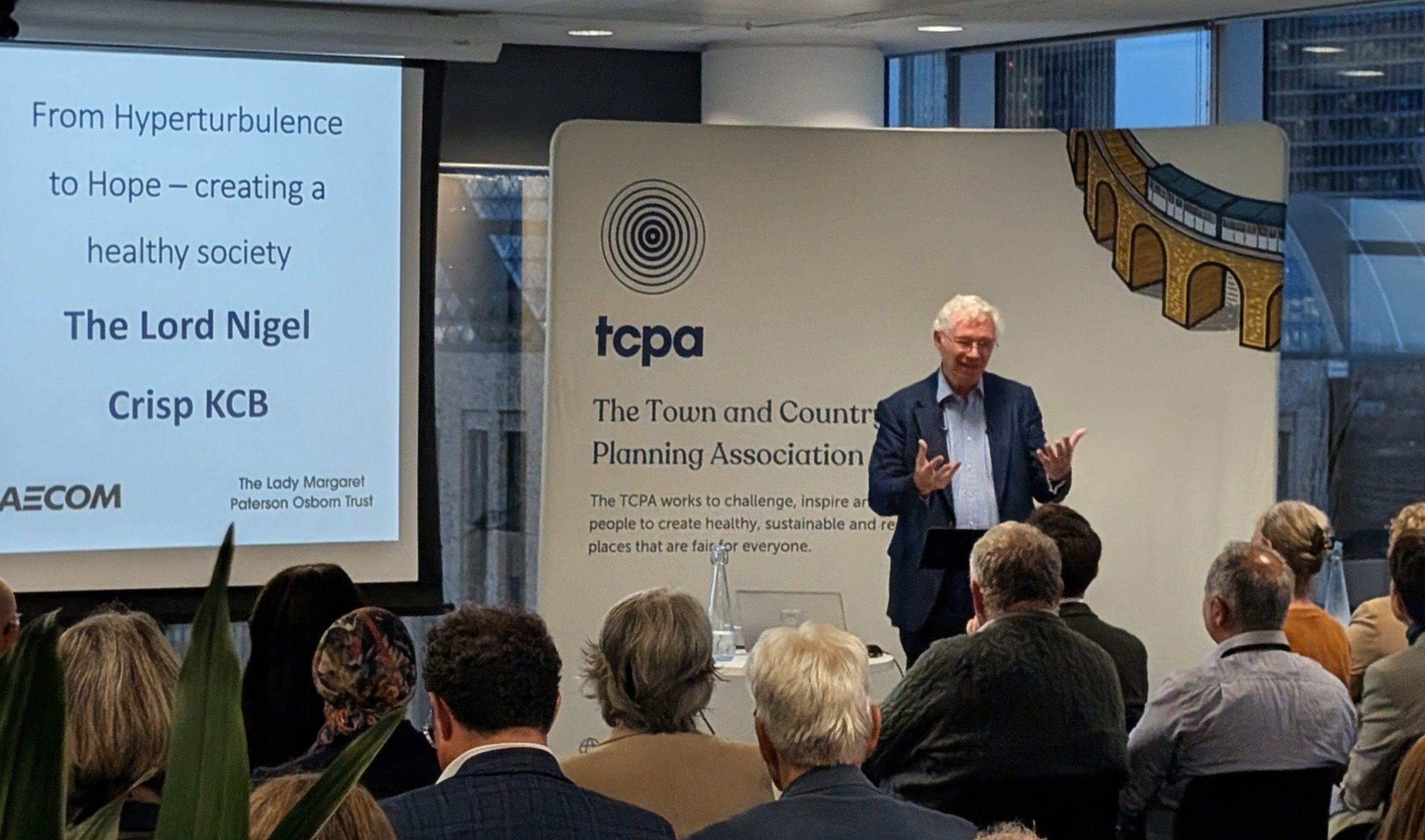
Lord Crisp’s lecture, which shares its title with his new book, argued that we are living through ‘hyperturbulence’:
“If you look at it globally – climate change, wars, mass migration, AI, autocrats, reckless capitalism – it’s hard to know where you can plant your feet.
“The ground doesn’t feel secure underneath you, does it?”
But in times of turbulence, there are opportunities for change, such as the huge achievements after the Second World War.
Innovation has always come from outside the system. Speaking about the five topics of education, health, jobs, housing and welfare, Lord Crisp made the point that people are already showing us the way.
He pointed to pioneers pushing at the boundaries, from social prescribing, which grew from a handful of places into national policy, to flexi schools and community health workers.
In planning and the built environment, this has led to a situation where some of the best practice, such as work by organisations like Incredible Edible which Lord Crisp cited, happens outside, rather than because of, the system.
“People in all these areas are doing these things. They’re pushing at these boundaries while the state is still stuck.”
Toward a shared vision
If the many innovative actions to create a better society are a reason to be hopeful, how do we turn that into real, and a healthier society?
Lord Crisp argued that what we’re really lacking is shared vision of creating a healthy society. And to get there, he said, we need to change the way we think about the future.
Speaking about the built environment, he said:
“We’re already seeing extraordinary evidence of what works – real data about nature and about architecture and about arts, and what doesn’t work, the unhealthy homes.
“I’ve seen and heard of thousands of small and larger projects really pushing at the future, really pushing to make changes happen.
“What I don’t see yet is the vision and moral imagination to be really taking that forward. And that’s one of those roles where the TCPA can make a real difference.”
This event was kindly supported by the Lady Margaret Paterson Osborn Trust and hosted by AECOM.